
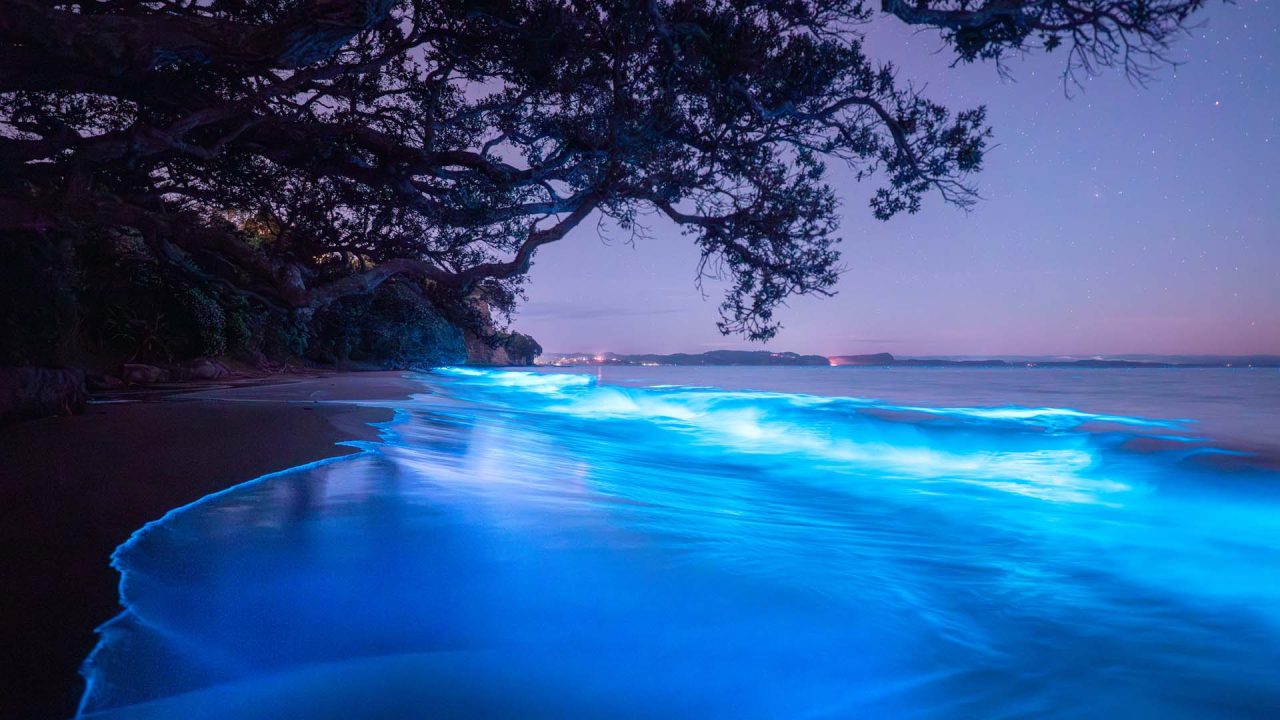
It has been at least a couple of years since Auckland hosted a truly spectacular bioluminescence show. We’ve seen a few minor events with decent photo opportunities, but nothing compares to those rare, incredible nights where the entire ocean seems permanently lit – where every breaking wave lights up the beach, and a million sparkles cascade down the rocks as the tide retreats.
That all changed when nature gifted us three days of the most intense bioluminescence imaginable. Without exaggeration, it was one of the finest displays I have witnessed in person or seen recorded anywhere in the world.
On Friday, November 7, 2025, reports began flooding in that the beaches around the Whangaparaoa Peninsula had turned a deep, pinkish-red. I knew straight away that it was dinoflagellates, the organisms responsible for that night-time glow. I immediately checked the latest satellite imagery. I was stunned to see the largest algal bloom I had ever encountered on a satellite map. It stretched across the northern side of the peninsula, extending all the way to Tiritiri Matangi and Kawau Islands, and out toward Rakino and Waiheke. For a show like this to occur, a specific recipe of conditions is required. While nothing is guaranteed, experience dictates the usual process: heavy rain creates nutrient-rich runoff from the land, followed by several days of hot, calm weather allowing the dinoflagellates to multiply in the sunlight. Finally, favorable winds and tides must align to push the bloom toward the coast, with just enough surface chop to disturb the algae and trigger the light release.
Just after 5:00 PM, I drove out to Stanmore Bay. When I arrived, I was blown away. The density of the bloom had turned the sea a vivid blood-red. Standing there in the daylight, I knew we were in for an unforgettable night.

By 8:00 PM, the sun had set. Although twilight still lingered, the crests of the waves had already begun to glow. By 9:00 PM, the show was in full swing. Every wave that rolled in ignited like crazy. Occasionally, a surge would wash right up to the base of the cliffs behind me, painting the entire beach in a stunning neon blue. As the water retreated, a million sparkles danced across the wet sand.
Larger waves crashed over the rocks, creating hundreds of miniature blue waterfalls as they drained away. Even the simple act of walking became magical with my feet lighting up with blue bursts every time they touched the sand. As the wind picked up, the entire ocean as far as the eye could see was illuminated in blue. It was a truly spectacular sight.
But nature wasn’t done yet. Around 11:00 PM, a near-full moon began to rise. We watched a massive, orange orb ascend from the horizon, casting a golden-yellow trail across the water that mingled with the blue of the waves. It is difficult to put such beauty into words, so I encourage you to look at the images and video below to see it for yourself.


By the next morning, the images had gone viral. I spent the day in back-to-back interviews as the photos made headlines in every major news publication across New Zealand.
Experience has taught me that these intense displays are usually one-hit wonders. Typically, the nights following a major bloom offer only a faint glow compared to the initial explosion of light. And that is exactly what happened. On Saturday night, I headed to Red Beach following reports of more activity. When I arrived, I was absolutely shocked – not by the bioluminescence, but by the people! The streets were gridlocked and parking was non-existent. I estimated there were at least 2,000 people there, all trying to catch a glimpse of the phenomenon. I admit, I felt a bit of guilt. It was largely my images and the resulting media coverage that had summoned such a massive crowd. A few locals even recognised me, jokingly blaming me for the traffic chaos. While the light show itself wasn’t nearly as impressive as the previous night, it was great to see so many people out, listening to the collective oohs and aahs whenever a brighter wave rolled in.
But Mother Nature wasn’t done yet. In fact, she was only just getting started. What happened over the following 24 hours would result in a spectacle that will stay with me for the rest of my life.
By Sunday, I was fighting off serious sleep deprivation, but a look at the latest satellite imagery woke me right up. It showed a massive concentration of algae sitting directly north of Waiheke Island. A friend on the island confirmed it, messaging me to say she could see tons of it from her balcony. At 7:00 PM, I made a frantic decision. While most of my photographer friends were heading to Orewa (where the beaches had been pink all day), I decided to take a gamble. I jumped on a bus to the city and raced to catch the next ferry to Waiheke. It was incredibly stressful. Thankfully, my friend met me at the ferry terminal, but we were racing against the sunset.
We quickly scouted the beaches to find the bloom before darkness fell. Oneroa was our first stop; it had a little activity, but nothing spectacular. Next was Sandy Bay, which showed promise with a nice bloom near the rocks, but I knew we could do better. Our final stop was Enclosure Bay, and I couldn’t believe my eyes. The water here was different. The bay was choked with a bloom so thick it looked like red jelly. Even better, because we were on Waiheke, there were hardly any people around.


Then, I witnessed something I thought was impossible. While the sun was still up – just before true sunset, the edges of the rocks started to glow. I have never seen bioluminescence compete with daylight before, but there it was, happening right in front of me.


Here’s another photo as the sun was going down. Stunning glowing rocks with the sun STILL OUT!


As the sun finally dipped below the horizon, the spectacle truly began. The bioluminescence was generating so much light that it was enough to illuminate the water from within, meaning we could still distinguish the deep, blood-red color of the algal tide even as the sky went dark.

At times, the entire bay would be permanently lit up.

The highlight of the night was the waves crashing onto the small beach. They rolled in deep, illuminating a stretch of sand three or four meters wide. As the water receded, it left the beach glowing with an intensity that didn’t seem to fade. The display produced so much light that I found myself constantly glancing back, convinced that a car had pulled up behind me with its high beams on. It was the closest thing to the world of Avatar that I have ever experienced. For a long time, I put the camera aside and simply sat on the rocks, admiring the magic of it all.


If you look closely, you will see that every single wave contains millions of tiny, individual sparkles.

Waves crashing over the rocks always make for stunning photography. I particularly love the effect created as the water recedes, forming countless miniature waterfalls of light that spill over the stone. I admit I got a bit carried away and captured (and posted) far too many images, but I simply couldn’t help myself. I’ll leave it to you to browse through the gallery and pick your favourites.


The show was so mesmerising that I made the decision to stay the entire night, photographing non-stop until the sun rose the next morning. Despite the exhaustion, I didn’t care. I knew I was witnessing a once-in-a-lifetime phenomenon, and I refused to miss a second of it.
As dawn broke, I finally packed up my gear and boarded the first ferry back to Auckland. I was wet, cold, covered in algae, and I absolutely reeked of the ocean. I can only imagine what the neatly dressed business commuters heading into the city thought of the disheveled mess sitting among them. It was the perfect, messy end to an unforgettable adventure, and looking at these photos, I’d do it all again in a heartbeat.
All images ared Copyrighted 2025, Extreme Pursuit.