
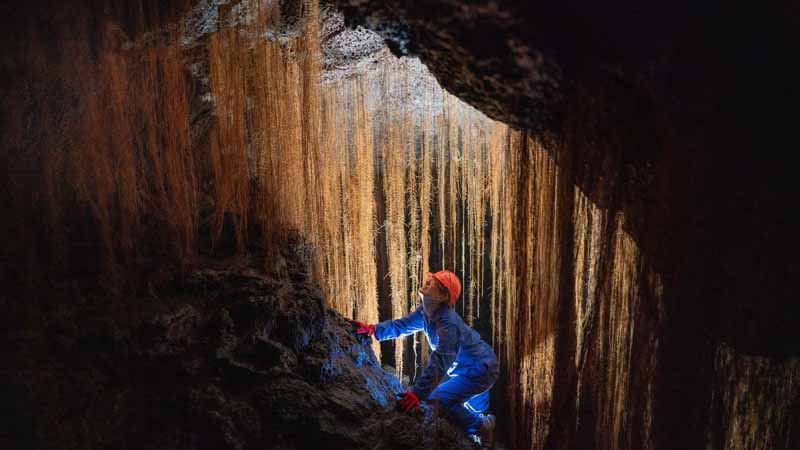
I recently had the privilege of co-leading a visit of Stewarts Lava Cave in Three Kings, Auckland, alongside Peter Crossley for Earthfest 2025. The response was overwhelming, with demand far exceeding capacity. To ensure those who missed out can still experience the site, I have developed a virtual tour below, encompassing the same insights and geological history covered during the event. I would also like to extend my sincere gratitude to the property owner for graciously granting access to the cave.

Cave Overview
Stewarts Lava Cave is one of Auckland’s most significant and well-preserved lava tubes. Located in the suburb of Three Kings (Auckland, New Zealand), it is a geological remnant of the Three Kings (Te Tatua-a-Riukiuta) volcanic eruption. Unlike many other caves in the region that have been destroyed by quarrying or urban development, Stewarts Lava Cave remains largely intact beneath private residential properties.
The cave was formed approximately 28,500 years ago during the eruption of the Three Kings Volcano. It is a classic lava tube formed when a river of low viscosity basaltic lava flowed from the volcano. As the outer layer of the flow cooled and hardened into a crust, the molten lava inside continued to flow. eventually draining away to leave a hollow tunnel. The cave is a complex system with only one surviving entrance and a total length of approximately 180m.
The cave was initially discovered in 1850 by R. Taylor. However, it is named after James Stewart, who conducted a detailed survey of the cave a number of years later. This survey is believed to be the first comprehensive cave survey undertaken in New Zealand.

Cave Access
Access to Stewarts Lava Cave is strictly controlled and unique because the cave system lies entirely beneath private residential land. Access is generally limited to scientific groups, researchers, or special events such as the Earthfest field trip.
Cave Entrance
Historically, the cave had two entrances. One entrance was subsequently backfilled with rubble and boulders to accommodate the construction of a residential driveway and garage. The only remaining entrance is located in a private backyard and is surrounded by a cinder block fence with a locked metal gate. This part of the cave has been modified quite extensively.

The rail tracks and concrete infrastructure at the entrance point to the cave’s industrial past. During the mid-20th century (peaking in the 1960s), the site functioned as a commercial mushroom farm. The lava tube offered a consistent, cool, and humid environment perfect for cultivation, while the rail system facilitated the transport of heavy equipment and produce.

Immediately upon entry, the floorboards of the house built directly overhead are visible. The rock roof here is remarkably thin, with less than a meter of separation from the surface in some spots. The cave system extends underneath the boundaries of roughly six properties.
The Main Chamber – The “Ballroom”.
A short descent leads into one of the cave’s largest chambers with a distinctively flat floor. This flatness is a tell-tale sign that the lava slowed down and ponded here. The immense heat and pressure from this ponded lava likely forced the semi-molten roof to inflate and rise while simultaneously melting the side walls outward. This section spans approximately 14 metres at its widest point and reaches a height of 8 metres.


Narrow sections of the cave mark steep areas where lava flowed fast, or choke points where cooling rock layered on the walls, gradually constricting the tunnel like a clogged artery.
Drip Features
Superheated gases from the existing or secondary flows trapped near the ceiling have remelted the rock lining, causing it to drip downwards like wax before solidifying. If these molten droplets hit a floor that has already stopped moving, they build up into small, knobby mounds known as drip stalagmites. My exploration of this cave has not located any stalagmite features.

Small Chimney
A chimney is a vertical vent drilled upward by high-pressure gases. They’re sort of pressure relief valves. This one didn’t make it to the surface however. If the chimney breaches the surface and spatters lava, it builds a hollow, cone-shaped mound around the vent called a hornito (Spanish for “little oven”). There are two larger chimneys located in the secondary passage towards “Fat Man’s Misery”.

Cooling Cracks
As you scan the ceiling and walls, you will notice a network of deep fractures running through the rock. These are known as cooling cracks or contraction joints. As the molten basalt cooled down it lost volume and shrank. This thermal contraction created tension in the solidifying rock, causing it to pull apart and fracture into the jagged patterns we see today.

Cave Colours
Contrary to the belief that volcanic environments are defined solely by dark basalt, Stewarts Lava Cave exhibits a remarkable colour palette. The interior is anything but monotonous, featuring distinct and varied colouration throughout the system.
The Gold
The shimmering gold on these walls is usually the first thing people ask me about. Is it real gold? Unfortunately, no – gold is almost never found in lava caves! While some attribute the “cave gold” to a layer of hydrophobic bacteria, my interpretation is that the yellow/gold colour comes from hydrated iron oxides leaching directly from the basaltic rock. The sparkle is not bioluminescence, but rather an optical effect caused by light refracting through tiny water droplets that bead on these mineral surfaces.

The White
These white formations are secondary mineral deposits, likely composed of Silica or Calcite. They occur when rainwater leaches minerals from the overlying rock. As the water seeps into the cave and evaporates, the dissolved minerals precipitate onto the walls.
It’s not just minerals painting these walls white. In some spots, it’s actually life. Small sections are created by bacteria forming thin layers called biofilms.

The Yellow And Brown Rust
The yellow and brown staining on the rock face is a sign of iron oxide alteration. Auckland’s basalt is iron-rich and as oxygenated water interacts with the rock, it oxidises the surface. Essentially, we are looking at geological rust.

The First Junction
Approximately 20 to 30 meters beyond the main chamber, we arrive at the cave’s first junction. Here, the lava flow splits into two separate tubes. The path to the right narrows rapidly, quickly becoming impassable. Our route lies to the left…but keep your head down. The ceiling drops significantly here, requiring us to duck to make it through.

The Drop
After squeezing through the narrow passage for about 10 to 15 meters, we arrive at a feature known simply as ‘The Drop.’ This is a steep, 3-meter descent angled at approximately 45 degrees. While it is possible to free climb down, we rigged a safety line for the group to ensure everyone reached the bottom easily. This chamber is also the home of the cave’s most impressive Pohutukawa tree roots. They are a stunning sight, but a word of caution: never grab them for support. They are far more fragile than they look and can easily break.
The Drop is a lava cascade or lava fall. It occurs when the molten river flowing through the cave encounters a steep drop in the underlying terrain, cascading down to a lower level. If you look closely, you can still see the vertical flow lines preserved in the rock face.

Pohutukawa Tree Roots
As the lava cooled, it contracted and fractured, creating a network of vertical fissures known as cooling cracks. Rainwater washes soil and organic debris into these thin cracks. The tree roots follow this. Eventually, a root tip emerges from a crack in the cave ceiling. In most trees, hitting open air would cause the root tip to dry out and die. However, species like the Pohutukawa are evolutionarily equipped with aerial roots. Instead of dying, the root changes structure to become a thick, bark-covered fibrous cord. It hangs suspended in the cave’s high-humidity atmosphere, absorbing moisture directly from the damp air.


Tube-in-Tube Cave & The Second Junction
At the base of The Drop, an additional tube heads off back upstream. My interpretation is that this is a tube-in-tube section. A tube-in-tube cave is where a smaller, secondary lava tube solidifies within the void of a larger, pre-existing master tunnel. This occurs when a fresh law flow enters the existing cave along the floor of a partially drained tube. Because the outer cave already provides insulation, this inner river creates its own cooling crust which then forms its own, distinct hollow tube.
We skipped the secondary tube near The Drop this time, but having explored it before, I describe the route near the end of this tour.
Flow Ledges
Moving forward another 30 meters, we pass a series of distinct shelves lining the walls known as flow ledges. Think of these as lava ‘high-tide marks’ or curbs made of rock.

Rafted Blocks
Just before we arrived at another junction put, we find ourselves amongst massive boulders which are rafted blocks.
They likely originated from the ceiling, crashing down as the cooling rock contracted and fractured. Their smooth, rounded edges suggest they crashed into the molten lava flow while it was still active. The intense heat partially remelted them as they floated downstream, rafting along the current until they either jammed in a narrow choke point or were left frozen in place as the lava drained away.

The Third Junction
At this point, the cave splits for the third time. Geologically, this is a classic example of flow diversion. Just as water flows around a boulder in a stream, the molten lava hit a significant obstacle here – likely a jam of cooled debris or a large section of collapsed roof. To keep moving, the lava river had to separate, carving out two distinct tunnels around the obstruction before eventually rejoining.
We took the left-hand passage again. While the right-hand tunnel does technically loop back around, completing the circle around the obstacle, it constricts significantly and is too narrow for us to navigate.
Shortly after, the cave narrows and marks the end of the passage.

The Secondary Tube at The Drop
We skipped the secondary tube near The Drop this time, but having explored it before, I can describe the route. Past a few small rafted blocks, the tunnel tightens after 10 meters. You must drop to your knees for a muddy, wet crawl that lasts for roughly 20 meters. When you can finally stand, you are greeted by a larger chimney—much larger than the earlier one. From there, the passage opens up, passing one final chimney before hitting a junction.

The (now blocked) Second Entrance
Heading upward to the right, the passage is immediately blocked by a chaotic pile of rocks. This tunnel once led to the cave’s original second entrance, but it was sacrificed and filled in to make way for a residential driveway and garage.
Fat Mans Misery
Heading to the left leads to a section known as ‘Fat Man’s Misery.’ True to its name, this is an extremely tight part of the cave that accommodates only slender cavers. Navigating it requires squeezing into a narrow gap, then abruptly twisting your body to the left to worm your way through.

However, once you’re through, you are rewarded with a very large passage and chamber that produces an echo, which is quite rare in a lava cave.

For an in-depth look at Auckland’s Lava Caves, their unique features, and the details of our exploration, follow this link