
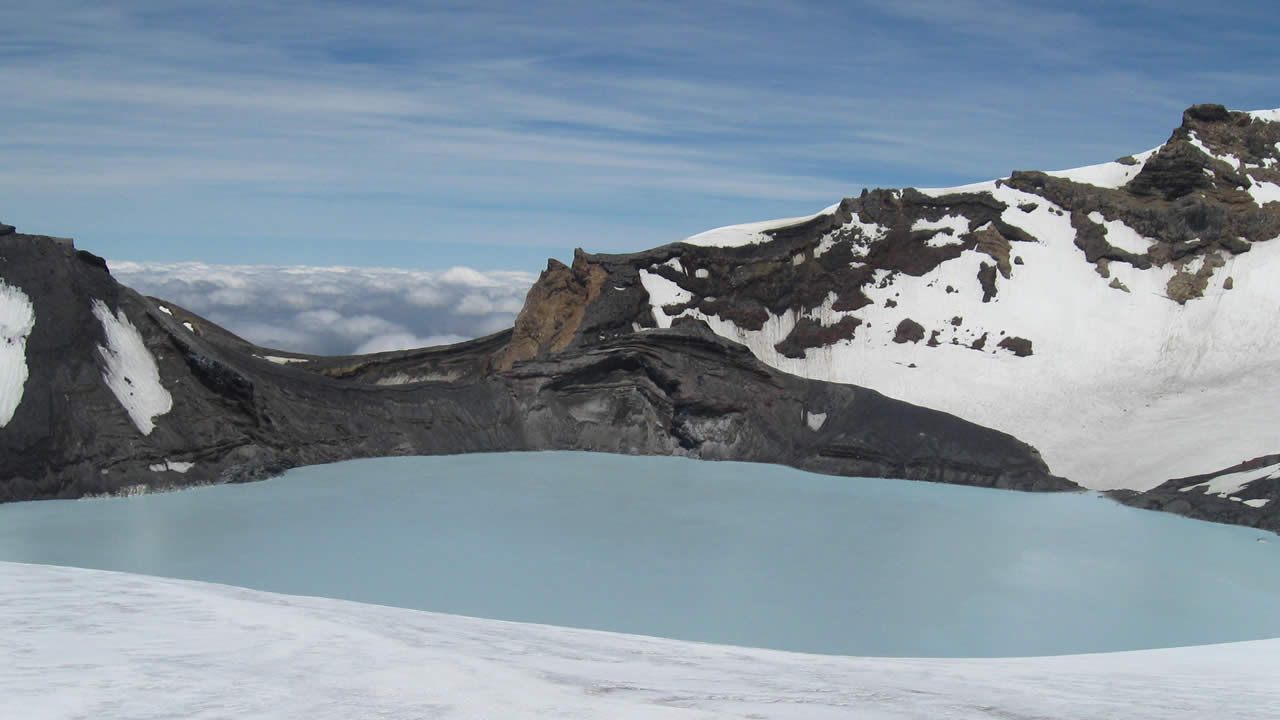
Last week, Geonet raised Ruapehu’s Volcanic Alert Level to Level 2. A new crater lake heating phase has begun, accompanied by strong volcanic seismicity. Ruapehu typically undergoes heating and cooling cycles, reaching upwards of 40°C before cooling to below 20°C. This pattern is not unusual. What is unusual is the rate of temperature increase considering the increase in gas flow. A new cooling phase ended on March 13 with crater lake temperatures declining to 27-28 °C – and again rising to 31°C on March 21.
A week later, the temperature has only risen by 1°C. There is a possibility that the vent beneath the lake is blocked and sealed, restricting the flow of super heated gas that normally heats the lake. A pressure build up could cause a catastrophic failure of the seal, resulting in an eruption. It could also dissipate as well.
The last eruption in Ruapehu (2007) was similarly caused by a breach of the seal beneath the crater lake, caused by an overpressurisation of super hot gas. The explosive, surtseyan style eruption lasted about 10 minutes and covered the summit area in ashfall and mud. Most of the ejecta was from the lake floor, including large blocks which were ejected as far as 2km from the crater. In the days after this eruption, up-welling areas were again visible across both vents and the crater lake temperature increased from 13°C to 20°C. The blockage had been cleared in a relatively small and quick eruption.
Eruption of 2007 – Source: GeoNet

This doesn’t mean Ruapehu is about to blow and more likely we won’t see an eruption. Additional warning signs to look out for include increased seismicity – particularly at more shallow levels and changes to the crater lake chemistry and temperature.