
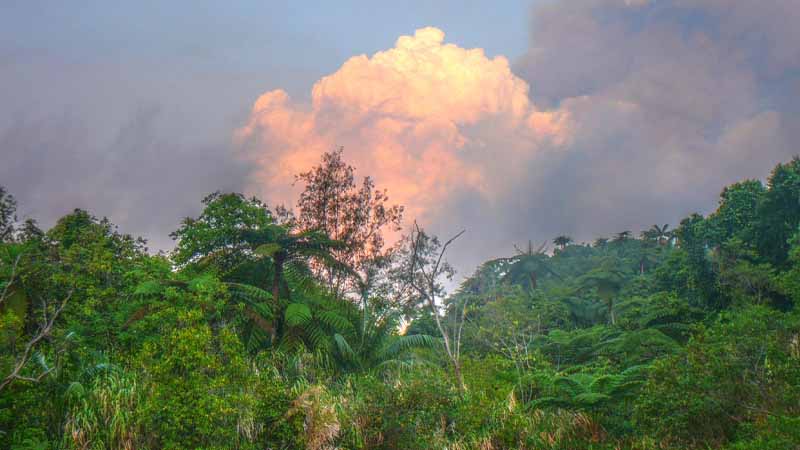
In 2018, a fissure eruption began inside the caldera of Ambrym volcano in Vanuatu. The eruption was preceded by strong seismic activity and rapid ground cracking, and within a short time, the island’s prominent lava lakes had drained. Ash and volcanic gases filled the air as new fissures opened across the caldera.
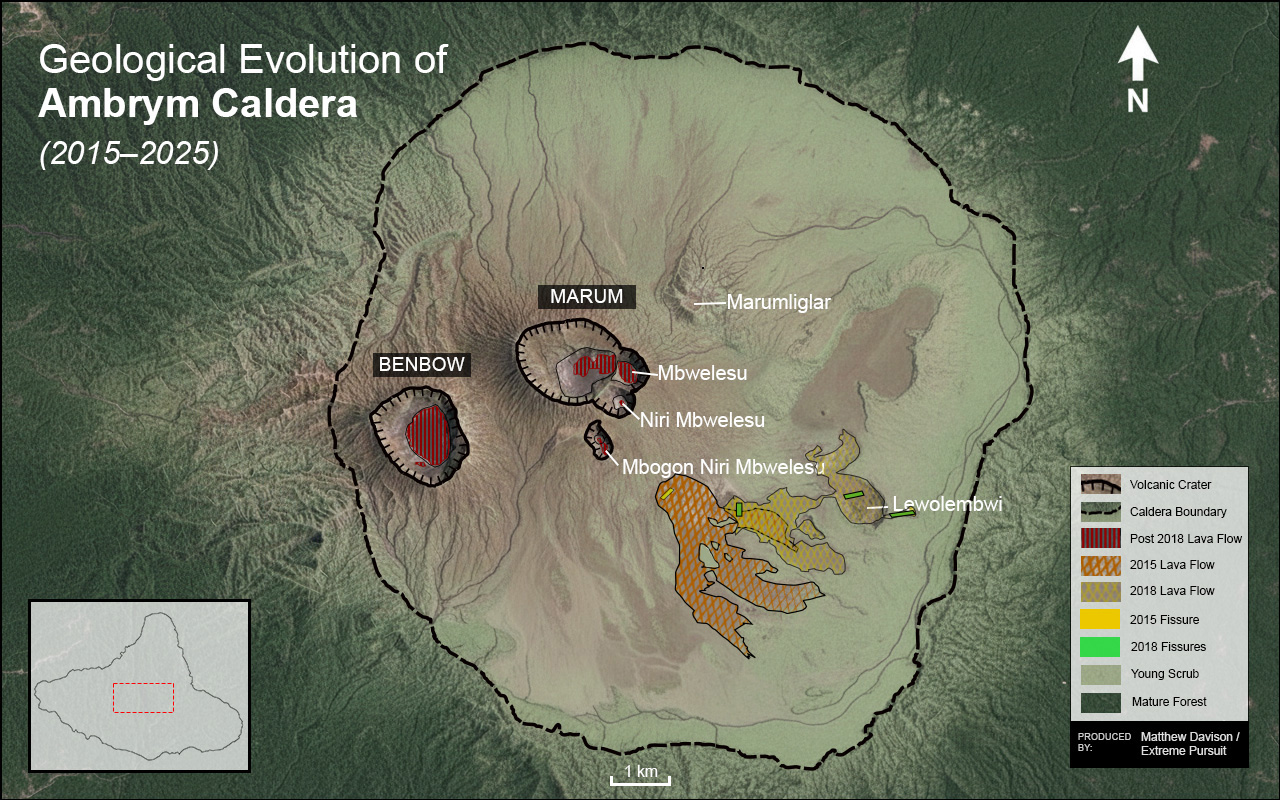
Ambrym is one of Vanuatu’s most active volcanoes, located in the centre of the Vanuatu archipelago. The volcanic island is dominated by a large caldera, roughly 12 km across, formed by a series of major eruptions thousands of years ago. Within the caldera are several volcanic cones and craters, including Marum and Benbow, which have hosted lava lakes and frequent eruptive activity.
The geological evolution of Ambrym’s Caldera, showing 2015, 2018 and post 2018 fissures and lava flows.
Because of Ambrym’s remoteness and the small number of people who visit the island, firsthand accounts and documentation of the events before, during and after the eruption are limited. I recently spoke with Benoit Rosa, a hiker from France who was inside the caldera when the eruption began, and John Tasso, a local guide who was also crossing the caldera that day. Their accounts, along with previously unseen photographs and video, offer a rare firsthand look at what unfolded.
On December 15, 2018, Benoit had made his way up to the caldera from Ranon, a village in the north of the island. When he arrived, a deep rumbling could be heard echoing across the caldera. His guide and porters initially thought it sounded like a distant thunderstorm, but the noise was coming from the volcano itself.
There was no visible ash or significant gas emission at the time. Rumbling is not unusual at Ambrym, even at Alert Levels 1 and 2, so the group decided to continue towards the Marum cone.
Meanwhile, John Tasso was approaching the volcano from Port Vatu on the southern side of the island. His plan was to meet Benoit at Marum Crater before guiding him and the rest of the group across the caldera to West Camp, then back down to Port Vatu.
At 10:20am local time, as John was making his way near Niri Taten, he heard a loud bang followed by a noise that sounded like a jet engine. A fissure had opened approximately 3 km southwest of the Marum cone.
The fissure stretched around 400 metres long, with lava fountains reaching more than 300 metres into the air. It was the beginning of a rapidly changing scene across the caldera.
Two more fissures opened shortly afterwards, one within the old Lewolembwi crater and another further to the southwest.
As John continued towards the summit of Marum, the fissures remained active. When he reached the crater, Marum’s lava lake was still visible. Within around 10 minutes, however, it had disappeared.
The lava lake had drained.

John was able to capture two photographs showing the dramatic change, one with the lava lake still present and another taken shortly afterwards showing the crater completely drained.
Just before midday, John met Benoit and the other guides at the summit of Marum. Benoit and his group also photographed the crater, by which point there was no visible lava remaining.
The last ever photo taken of Marum’s pit crater – just drained.

The last photo ever taken of Marum’s crater, before catastrophic subsidence and collapse.

From there, John led the group back down towards the south, passing between Niri Mbwelesu, Mbogon collapse pit and Niri Mbwelesu. As they descended, conditions began to deteriorate. Ash and volcanic gases became increasingly heavy, while the fissures continued to erupt.
Benoit and his group managed to capture footage of the fissure eruption, although visibility was becoming increasingly difficult through the thickening ash and gas.
By around 2pm, the group had reached West Camp on the edge of the caldera. The fissure was still erupting, and they remained at the camp until approximately 3:30pm before beginning their descent towards Port Vatu.
The main fissure eruption, taken from the edge of the caldera (near West Camp)

The duration of the fissure eruptions remains unclear. At least three fissures opened, producing lava flows. As the group traveled to Craig Cove, they observed a vivid red glow, suggesting that fissure activity was still ongoing.
Their timing proved fortunate. As they approached Port Vatu shortly before sunset, they looked back towards the volcano and saw large eruption plumes rising from the caldera.


The eruption continued and intensified the following day, December 16, with ash plumes eventually reaching around 8 km above the volcano.
If you’d like to learn more about the 2018 Ambrym eruption, including what caused it and what happened in the days and months that followed, click here.
A huge thank you to John Tasso and Benoit Rosa for sharing their firsthand accounts. Photos courtesy of Lionel Laloy and Benoit Rosa.